Linux server security software as a category has ballooned into marketing language faster than it's ballooned into actual capability. This guide cuts through that: what the category should mean by 2026 standards, what a host-based agent can and cannot realistically do, and how to roll one out across a fleet without breaking anything or missing the compliance paperwork.
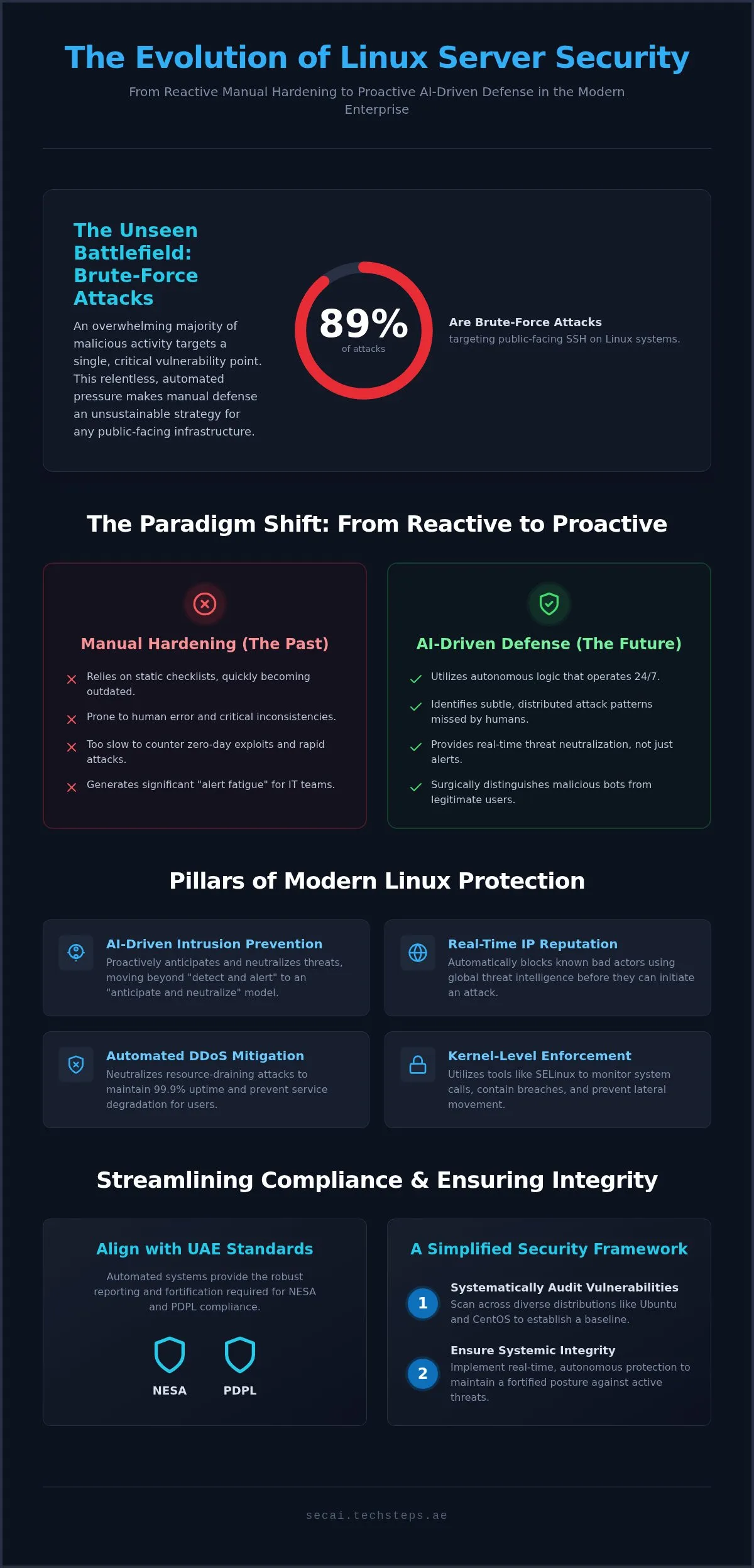
Brute-force attacks targeting public-facing SSH remain the single most common thing IT teams deal with on Linux systems, reason enough that manual, checklist-based hardening stops scaling past a handful of servers. As the Linux kernel moves through the 7.1.x series and Ubuntu 26.04 becomes the default enterprise base, the demand for software that handles this automatically, not just documents it, keeps climbing. Add NESA or PDPL compliance reporting on top and manual operations stop being merely tedious, they become a real liability.
Key Takeaways
- The shift from static firewalls to behavior-based, AI-assisted detection is a genuine capability change, not just a marketing relabel, but it changes the degree of automation, not the underlying tradeoffs of automated blocking.
- Manual hardening doesn't survive a growing fleet. The volume of brute-force noise alone makes human-only response unsustainable past a few servers.
- Real linux server security software pairs automatic IP reputation blocking with DDoS handling scoped honestly to what a host-based agent can actually stop.
- Auditing every distribution in a fleet, Ubuntu, CentOS, RHEL - for unpatched packages is table stakes, not a differentiator.
- NESA and PDPL compliance depends on continuous evidence, not an annual scan. Tiered protection plans exist to make that evidence collection automatic.
Table of Contents
- What is Linux Server Security Software in the AI Era?
- The Shift from Manual Hardening to AI-Driven Autonomous Defense
- Essential Features of Enterprise-Grade Linux Protection
- Implementing a Robust Security Layer for Your Infrastructure
- SecAI: Built for Linux Specifically
What is Linux Server Security Software in the AI Era?
Modern linux server security software isn't a passive shield anymore, it identifies, blocks, and in some cases predicts threats against the kernel and whatever's running on top of it, without a human triggering every action. That's a real shift from "detect and alert," where a person still has to act on every finding. The honest caveat: automation only helps with threats it can act on unilaterally and safely. Anything ambiguous still needs a human, and any vendor implying otherwise is selling you something.
Manual monitoring is too slow for exploits that get weaponized within hours of disclosure, that part isn't marketing, it's just true of the CVE-to-exploit timeline in 2026. Automating detection and response is how a small team keeps uptime high without living in the terminal at 3am.
Key Components of Modern Linux Defense
Continuous detection matters more than scheduled scanning, because a scan only tells you what was true at the moment it ran. Automated IP blocking driven by reputation intelligence stops known-bad sources before they reach a login prompt at all. Deeper protection happens at the kernel level, tools like SELinux enforce restrictions on system calls, so that even a compromised application can't spread laterally.
Why UAE Businesses Prioritize This
UAE enterprises are aligning infrastructure with national digital transformation goals, which puts real weight on demonstrable resilience, not just described policy. Compliance here isn't a checklist exercise, regulators and enterprise customers alike expect evidence that controls are actually running, which is a software problem as much as a policy one.
The Shift from Manual Hardening to AI-Driven Autonomous Defense
Sysadmins have relied on static checklists and manual configuration for years, see our own hardening checklist for what that looks like done well. The problem isn't that manual hardening is wrong, it's that it doesn't survive scale. Most of what shows up as "attacks" against a public-facing server is brute-force noise, and having a human manually block IPs or tune firewall rules against that volume is a losing trade of time.
The NIST Guide to General Server Security is still the right foundation for the underlying principles. What's changed is execution: applying those principles by hand doesn't scale past a handful of hosts. An automated system can correlate a distributed attack across fifty source IPs hitting the same exploit in parallel, a pattern a human reviewing logs one server at a time will likely miss entirely.
Overcoming Alert Fatigue
The real cost of legacy tools isn't that they miss things, it's the noise, alert triage, not raw detection, is the actual bottleneck for security teams at any scale. Software that distinguishes bad actors from legitimate traffic with enough precision to auto-resolve most of it turns a sysadmin's day from monitoring alerts into reviewing decisions already made. That's hours back every week, not a hypothetical.
Predictive vs. Reactive Security
"Predictive" gets thrown around loosely in this space. What it actually means in practice: using historical and real-time threat intelligence to pre-position defenses against known attack patterns before they hit your specific server, not clairvoyance about zero-days nobody's seen yet. That distinction matters if you're evaluating a vendor on this claim.
Essential Features of Enterprise-Grade Linux Protection
Enterprise-grade protection means real-time intrusion prevention at the edge, before traffic reaches your applications, plus the ability to scale from one server to a full fleet without switching tools. SecAI covers the second part: the same agent runs on every server, and the plans go from a single server, on a free plan or a paid one, up to Enterprise fleets.
Logging and reporting matter as much as detection for UAE businesses specifically, because NESA and PDPL compliance is a documentation problem as much as a technical one. Software that generates audit-ready evidence automatically turns compliance from a manual scramble before an audit into a byproduct of normal operation.
DDoS Mitigation for Small and Mid-Sized Businesses
SMBs get hit by application-layer DDoS as often as anyone else now, these attacks exhaust server resources and sometimes serve as cover for a more targeted exploit underneath. Worth being precise about what host-based software actually does here: it identifies and drops malicious traffic from identifiable sources automatically, which genuinely stops application-layer floods and credential stuffing. It does not stop a volumetric attack that saturates your network link before your server ever sees the packets, that has to be handled upstream, at your provider or a scrubbing service. Any vendor that doesn't draw this line clearly is being imprecise on purpose or by accident, and neither is what you want from a security vendor.
Automated IP Reputation Management
Static firewall rules can't keep pace with how fast malicious IPs rotate. Reputation-based blocking checks a connection against global threat intelligence before it's accepted, rather than waiting for it to trigger a rule after the fact. The Red Hat Security Hardening Guide is still solid for the underlying manual configuration; reputation-based blocking is what layers automation on top of it.
Implementing a Robust Security Layer for Your Infrastructure
Installing a tool isn't the same as operationalizing it. The rollout that actually works follows roughly four steps:
-
Audit first. Scan every distribution in the fleet for unpatched packages and legacy configuration before doing anything else. You need the baseline before you can measure improvement.
-
Pick the right plan. SecAI's paid plans differ in how many servers they cover and how much history, alerting and AI auditing comes with them, not in the protection itself, and a free plan monitors a single server. Match the plan to the servers you actually run, not the highest tier available.
-
Deploy the agent. Lightweight, continuous monitoring, with automated responses configured for the unambiguous cases, repeated failed SSH attempts against Ed25519-keyed accounts, for instance.
-
Wire up reporting. Feed the output into your existing compliance workflow so security stays visible without someone manually pulling logs every week.
Meeting UAE Regulatory Standards
NESA compliance comes down to enforcing the right technical controls and being able to prove it. PDPL adds the data-integrity and access-control side on top. Automated, timestamped logs of every blocked attempt are the evidence an auditor actually wants, not a policy document describing what you intend to do.
Best Practices for Server Hardening in 2026
Disable what you don't use, see the hardening checklist for the specifics, in priority order. Least-privilege access matters more as attack surface grows, and it's exactly the kind of thing worth automating rather than re-auditing by hand every quarter. Worth saying plainly: hardening isn't a one-time task. New vulnerabilities land daily, and a server hardened once and left alone drifts out of that state within weeks.
SecAI: Built for Linux Specifically
SecAI isn't a general endpoint tool retrofitted for servers. It's built for Linux specifically, the kernel, the major distributions, the actual failure modes that show up on production boxes rather than desktops. That focus is the whole argument for it over a cross-platform tool: less surface area to get wrong, and detection tuned to what actually happens on a Linux server rather than a generic endpoint profile.
Protection That Scales With the Business
Every paid SecAI plan runs the same agent with the same detection, automatic blocking, AI audits and compliance reports. What changes from Pro to Plus, Business and Enterprise is how many servers are covered, how long incident history is kept, how many people receive alerts and how many AI audits a month are included. The free Community plan monitors a single server without automatic blocking or AI audits, which is a way to see what SecAI reports before deciding whether it should act.
For MSSPs
The white-label MSSP program lets partners run SecAI across a client portfolio from one console, under their own brand. It's the same problem this blog has covered before: alert triage, not raw detection, is what decides whether a security practice scales profitably, this just gives you the tooling for it. Learn more about the MSSP program.
Where This Leaves You
The move from manual hardening to automated, always-on defense isn't optional past a certain fleet size, it's the only way the economics work. Continuous detection handles the volume; the remaining human time goes to the decisions that actually need judgment. NESA and PDPL compliance falls out of that as a side effect, not a separate project, once logging and reporting are automated from day one.
See SecAI's tiered plans for what fits your current fleet size.
Frequently Asked Questions
What is the best security software for Linux servers in 2026?
Whichever platform is built specifically for Linux rather than adapted from a generic endpoint agent, and whichever one is precise about what it can and can't stop, particularly around DDoS, where vendor claims tend to blur volumetric and application-layer attacks together. SecAI is built Linux-first for exactly this reason.
Can AI-driven security software slow down my Linux server performance?
Well-built agents have negligible overhead, kernel-level monitoring done efficiently doesn't need the heavy deep-packet inspection older tools relied on. Worth checking a vendor's actual resource benchmarks rather than taking "lightweight" as a given; that word gets used loosely.
How does automated IP blocking differ from a standard firewall?
A firewall enforces static rules you wrote in advance. Automated IP blocking checks incoming connections against live reputation data and drops known-bad sources before they even complete a handshake, a meaningfully faster response than updating firewall rules after you notice something's wrong.
Is Linux server security software necessary if I already use a cloud provider's firewall?
Yes, a cloud firewall protects the network perimeter, not the operating system or applications running on it. It won't stop an exploit against a vulnerability in your specific Linux kernel version or a compromised application. The two layers solve different problems.
How do SecAI's tiered plans help with UAE NESA compliance?
Automated, timestamped logging of every detection and block gives you audit-ready evidence without manual log collection before a review. That's the actual compliance lever, continuous evidence, not a stronger policy document.
Does SecAI support all Linux distributions?
Current Debian and Ubuntu releases, and Rocky Linux, AlmaLinux and other RHEL-compatible distributions, on x86_64 servers with systemd.
What's the benefit of a white-label platform for MSSPs?
You get to offer Linux-specific, AI-assisted defense under your own brand without building the detection engine yourself, the same argument for buying versus building anything else in this space.
How does automated DDoS protection actually work for small businesses?
It filters malicious traffic at the server level for application-layer floods, where the source is identifiable and blocking genuinely stops the attack. For volumetric attacks that saturate the network link itself, mitigation has to happen upstream at the provider, no server-side agent can absorb bandwidth that's already consumed the pipe before it reaches you. Knowing which kind you're facing is the first useful diagnostic step, not the last.